MOT: Past, Present and Future
Tarek Khalil
President of Nile University
Founder, IAMOT
Management of Technology is a relatively young field of study, research and application. For many workers in this field of knowledge, it is important to understand its beginnings, the motivations and the imperatives that made many people in the US first and all over the world at a later time to pursue it as an independent entity. The factors that led to this are ingrained in historical events that I will attempt to briefly summarize here.
Following the Second World War, industries of the victorious western countries, particularly those of the United States that were unscathed during the war, dominated the scene. Large corporations such as General Motors, Ford, Westinghouse, DuPont, Dow Chemicals, steel industries, Aerospace industries etc. became very prosperous and their products dominated the national and the world markets. Many became multinationals and benefited from the growth period following the war. They participated in rebuilding the world economy. The Soviet Union also started rebuilding its industries, the Marshal plan helped Europe and McCarthy set a path for the start of recovery of Japan. The domination of the western industry and lack for true competition gave the managers of most US companies an air of invincibility and they became complacent, more interested in financial transactions with short term strategic outlook. Technology was relatively stable, and companies increased their profit by working to enhance labor efficiency. It was not until the 1970’s that the US industry, particularly the automakers, started to feel the pressure. The German and Japanese industries began to make a comeback and world competition started heating up. The giant US company Chrysler was on the brink of bankruptcy and the golden age of American dominance in the car industry has come to an end. It took an act of bailout from Congress and a major innovation effort by a visionary new CEO, Lee Iacocca to save the company for a while. In 1980, an article by Robert Hayes and William Abernathy appeared in the Harvard Business Review titled “Managing Our Way to Decline” blasted management for its failure to recognize and effectively respond to changes in the world. Edward Deming, the Guru of quality was touring the US talking about his experience in Japan and about the failure of US management. Business competitiveness has become no longer a matter of choice but a matter of survival in an increasingly competitive global market. What drove the change was initially the world energy crisis following the Middle East war of 1973 and the rapid pace of technological change led mostly by computerization and the advancement in information and communication technology. It was a sea change that ushered what I call the “Technology Age” as a substitute for the “Industrial Age”. During the Industrial age, the mechanical power replaced the human power but during the Technology Age -- sometimes dubbed as Knowledge Age -- information, innovation and the brainpower became the dominant factors for competitiveness. Fueled by the impressive speed by which we can manipulate data, technological progress advanced at unprecedented pace during the last four decades. Advances in communication and transportation technology brought the world closer together.
Many countries around the world emerged as strong competitors in the global arena, notably among those were the tigers of Asia, and more recently China and India. The US industries that once thought they were invincible found themselves in a fierce fight for survival.
They were losing business to European and Asian competitors. It was a shock to many that the country with the strongest science and technology establishments and the best business education in the world is losing the race for competitiveness and wealth creation. Several universities started to respond to the changing global forces by offering graduate education more relevant to the new realities. MIT initiated a Master degree program in Management of Technology (MOT) focusing on innovation and entrepreneurship. University of Miami initiated a joint MBA and M.S. in Industrial Engineering followed by a full M.S. program in MOT. Many universities in the US, Europe and around the world started activities in MOT. Others responded with some changes in programs and curricula that recognize the constant need for change and innovation.
Following some expression of anxiety and concern among US industries and government representatives, a workshop was held in 1987 by the National Academy of Engineering (NAE)/National Research Council (NRC) drew national attention to the problem. The workshop, that was attended by academicians, industry people and government officials, drew the conclusion that “Management of Technology is the Hidden Competitive Advantage” for organizations and that for companies to compete they must be able to integrate technology strategy with business strategy. The NAE/NRC workshop report recommended the following industry needs that should be addressed (NRC 1987):
-
How to integrate technology into the overall strategic objectives of the firm.
-
How to get into and out of technologies faster and more efficiently.
-
How to assess/evaluate technology more efficiently.
-
How best to accomplish technology transfer.
-
How to reduce new product development time.
-
How to manage large, complex and interdisciplinary or inter-organizational projects/systems.
-
How to manage the organization’s internal use of technology
-
How to leverage the effectiveness of technical professionals.
Research and education diverted towards satisfying these needs were deemed essential for US industry to regain its leadership position. Several other organizations and universities took note and pursued actions aimed to restore US competitive advantage.
The University of Miami decided to take the lead in launching the first international conference on Management of Technology in February 1988. The aim was to bring together educators and researchers, from several disciplines together with engineers and managers from industry and policy makers from around the world to present their views and discuss the particularities of this emerging interdisciplinary field. This activity was the first seed in the launch of the International Association for Management of Technology (IAMOT).
In 1988, the American Association of Engineering Societies published its report titled “Management of Technology: The Key to America’s Competitive Future”. The National Science Foundation in collaboration with the University of Miami sponsored a series of workshops to bring more focus and attention to the education and research needs of this newly identified interdisciplinary field. A 1988 workshop was held in Miami looked at technologies and the enablers to deploy them based on modified Engineering Management concepts used by IEEE transactions on Engineering Management. The workshop report (Khalil and Bayraktar, 1988) presented the challenges and opportunities for research in MOT classified under five enablers:
-
Methods and tools for managing technical resources.
-
Managing the interface between the organization and the external environment.
-
Management of technological organizations and technological change in times of high competitive pressure.
-
Management of R&D and engineering projects.
-
Management of human resources under conditions of rapid technological and social change.
Another workshop was held at the NSF headquarters in Virginia in 1995 came up with the following new MOT paradigms for managing the enterprise (Betz et al. 1995):
-
Value Creation.
-
Quality.
-
Responsiveness.
-
Agility.
-
Innovation.
-
Integration.
-
Teaming.
-
Fairness.
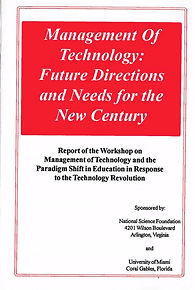
A 1998 NSF/UM workshop explored the areas of greatest concern to industry where global changes are taking place. The areas of greatest concern were classified under seven main headings as follows (Khalil, 1998):
-
Technology.
-
Changes in Business Environment.
-
Communication, Integration and Collaboration.
-
Strategic Directions Structure.
-
Financial Sector Structure.
-
Education and Training.
To propose a set of recommendation to the MOT community, another NSF/UN workshop in 2000 looked at the drivers of change in the twenty first century and the needed responses from an MOT perspective. The report of the workshop (Khalil, 2000) reiterated the importance of MOT in wealth creation and the role of MOT in leading the change. The following areas were recommended for emphasis by the MOT community.
-
Recognize innovation as the major driver for sustainable competitiveness and wealth creation.
-
There is a need to unify terminology, change cultures, modify strategic planning horizon, and develop a BOK for MOT.
-
The knowledge age has implications on managing knowledge, intellectual capital and liabilities, and the notion of value.
-
MOT community should lead organizational changes and recognize complexities and ethics.
-
Expand education and training of MOT as a separate field of knowledge.
IAMOT under the leadership of Professor Ryas Van Wyk published and debated a credo for MOT and Yanez et al., undertook the survey of the MOT community to establish guidelines for a Book of knowledge for MOT (Yanez and Khalil, 2007; Yanez, Khalil & Walsh, 2010), IAMOT used the accumulated knowledge of the past 20 years to establish an accreditation manual and accreditation board to evaluate and certify graduate program around the world.
During the 20th international conference on Management of Technology, I participated in a panel discussion to review highlights of the past, present and project the future of MOT. In my presentation, I reviewed the history mentioned above and concluded with a brief summary of observed changes in 30 years.
We moved from → to:
-
Narrow definition of technology → Wider one (Knowledge applied in service of humankind).
-
Traditional (stable) technologies → emerging, fast innovation based (Nano, Bio, Info).
-
The revolution technology → The technology of revolutions where sharing of knowledge through the internet and social media is contributing to revolutions and social change.
-
Regional impact with limited influence → World-wide impact with huge influence.
-
Focus on corporate problems → global societal problems (green, water, food, energy, security, poverty, wealth sharing and social justice.
Nowadays, we can confirm that MOT is as critical as ever. There is no doubt in my mind that MOT has had a profound impact on our lives in the past and will continue to do so in the future.
References:
- Hayes, Robert and Abernathy, William, 1980, “Managing Our Way to Decline”, Harvard Business Review, July-August.
- National Research Council, 1987, “Management of Technology: The Hidden Competitive Advantage”, National Academy Press, Washington, D.C.
- American Association of Engineering Societies, 1988, “Management of Technology: The Key to America’s Competitive Future”, AAES, Washington, D.C.
- Khalil, T. and Bayraktar, B., 1988, “Challenges and Opportunities for Research in the Management of Technology”, NSF/University of Miami Report.
- Khalil, T.M., Betz, F., Keys, K., and Smith, R., 1995, "Management Paradigms and the Technology Factor," Elsevier Science, Inc., Technology Management, 1:242-246
- Khalil, Tarek, 1998, “Management of Technology: Future Directions and Needs for the New Century”, UM/NSF report, The University of Miami.
- Khalil, Tarek, 2000. The Drivers of Technological Changes in the 21st Century, NSF/UM report, University of Miami, Coral Gables, Florida, January.
- Yanez, Mario and Khalil, Tarek, 2007, “An Accreditation Program for MOT Graduate Education: Recognition of Need and a Body-of-Knowledge Framework”, International Association for Management of Technology IAMOT 2007 Proceedings.
- Yanez, Mario, Khalil, Tarek and Walsh, Steven, 2010, “IAMOT and Education: Defining a Technology and Innovation Management (TIM) Body-of-Knowledge (BOK) for Graduate Education (TIM BoK)”, Technovation Vol. 30, pp 389-400.
Workshop reports: